
TL;DR:
- Personalizing AI chatbots enhances fan engagement by creating more human-like interactions.
- Use appropriate tools, clear data policies, and ethical data handling to ensure trust and compliance.
- Avoid over-personalization and maintain transparency to prevent damaging emotional or brand trust.
Imagine a fan sliding into your DMs after weeks of anticipation, and your chatbot fires back a robotic, one-size-fits-all reply. They unsubscribe within minutes. That scenario plays out thousands of times a day for creators who rely on generic automation. Personalized AI responses change the equation entirely. When your bot remembers a fan’s name, references past conversations, and matches your tone, it stops feeling like a script and starts feeling like you. This guide walks you through the tools, setup steps, common pitfalls, and optimization tactics you need to make AI-powered fan engagement feel genuinely personal.
Table of Contents
- What you need to personalize AI chatbot responses
- Step-by-step: Setting up and training your AI chatbot
- Avoiding common mistakes and edge cases in chatbot personalization
- Measuring and optimizing chatbot engagement
- Our take: Personalization that feels real without crossing the line
- Level up your fan engagement with Persona AI
- Frequently asked questions
Key Takeaways
| Point | Details |
|---|---|
| Start with safe data | Use ethical, transparent fan information and comply with all privacy laws. |
| Fine-tune for your niche | Specialized, NSFW-trained bots achieve the best engagement on adult platforms. |
| Balance automation and trust | Personalize where it helps, but always allow fans a direct human option. |
| Monitor and adapt | Regularly review conversations and adjust your chatbot for optimal results and safety. |
What you need to personalize AI chatbot responses
Before you can upgrade how your chatbot interacts with fans, ensure you have the right setup and understand key requirements. Personalization is not just a feature you toggle on. It is a system that requires the right tools, clean data, and a clear understanding of where the legal and ethical lines are.
Essential tools and requirements
Here is what you need before you start:
- A chatbot platform that supports persona customization and memory (conversation history storage)
- Fine-tuning options or prompt engineering capabilities so the bot mirrors your voice
- Consent and data tracking tools to log what fan information you collect and how you use it
- A content policy framework that defines what your bot will and will not say
- Analytics access so you can measure what is working and what is not
| Tool category | Purpose | Example use |
|---|---|---|
| Chatbot platform | Hosts and runs your AI persona | Persona management, DM automation |
| Fine-tuning or prompting | Shapes tone and personality | Matching your specific voice |
| Consent tracker | Documents data collection | GDPR compliance logs |
| Analytics dashboard | Tracks engagement metrics | Response rate, fan return rate |
Privacy and GDPR concerns are especially critical in adult creator contexts because you are handling sensitive personal data alongside explicit content. Fans share details they would not share elsewhere, and that data carries legal weight. Mishandling it can result in platform bans, legal action, or permanent reputation damage.
Start small. Use only the fan data that fans have voluntarily shared in conversation. Avoid scraping external profiles or purchasing third-party data. Ethical datasets built from real interactions produce better personalization anyway, because they reflect how your actual audience communicates.
Pro Tip: Before importing any fan chat history into your bot’s training data, remove identifying details like real names, email addresses, or payment info. Train on patterns and tone, not personal identifiers.
Step-by-step: Setting up and training your AI chatbot
With your tools sorted, it is time to set up and personalize your AI chatbot, step by step.
- Choose your chatbot platform. Look for platforms built for creators, not generic enterprise tools. You want native support for NSFW content, persona memory, and multi-platform deployment.
- Define your persona. Write a detailed persona document: your tone, vocabulary, topics you engage with, hard limits, and sample responses. This becomes the foundation of your bot’s personality.
- Import your persona data. Feed the platform your persona document, sample conversations, and any approved fan interaction scripts. The more specific, the better.
- Select your base model. You can use a general large language model (LLM) with heavy prompting, or a fine-tuned NSFW model. Fine-tuned models for NSFW show superior engagement over vanilla chatbots because they understand context that general models censor or mishandle.
- Configure memory settings. Enable conversation history so the bot recalls what fans said in previous sessions. This is what makes interactions feel ongoing rather than transactional.
- Set hard content boundaries. Define exactly what the bot will not say or do. Build these as hard-coded rules, not soft suggestions.
- Run a test batch. Before going live, simulate 50 to 100 fan conversations internally. Check for tone consistency, boundary violations, and factual errors.
- Launch and monitor closely. Go live with a small segment of fans first. Watch the analytics daily for the first two weeks.
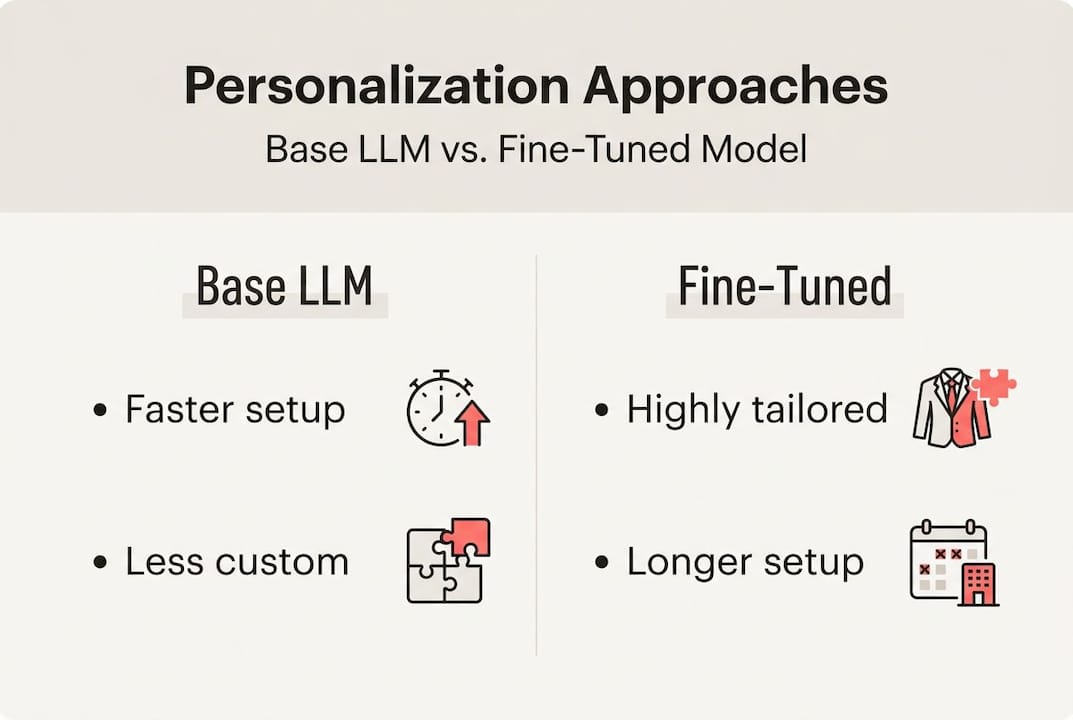
Base LLM vs. fine-tuned model: A quick comparison
| Factor | Base LLM with prompting | Fine-tuned NSFW model |
|---|---|---|
| Setup time | Fast (hours) | Slower (days to weeks) |
| Persona accuracy | Moderate | High |
| Content handling | Often restricted | Purpose-built |
| Cost | Lower upfront | Higher upfront |
| Long-term engagement | Decent | Significantly better |
Pro Tip: Even if you use a fine-tuned model, always layer your persona document on top as a system prompt. Fine-tuning shapes general behavior; your persona prompt shapes your specific voice.
Avoiding common mistakes and edge cases in chatbot personalization
Even with a well-personalized bot, pitfalls can undermine trust and effectiveness. Here is how to avoid the most common ones.
Top errors creators make
- Feeding the bot too much personal fan data. More data does not always mean better personalization. Referencing overly specific details can feel surveillance-like rather than warm.
- Ignoring privacy settings. Not all fans consent to having their messages stored or used for training. Always make data use clear in your terms.
- No fallback to a human. Fully automated systems fail fans in emotionally sensitive moments. Always build a trigger that flags conversations for human review.
- Inconsistent tone across platforms. If your bot sounds different on OnlyFans than on Fanvue, fans notice. Maintain one persona document across all deployments.
- Neglecting long chat histories. Bots can start to hallucinate (generate false or contradictory information) when conversation threads get very long. Set a context window limit and summarize older history instead of feeding raw logs.
“Over-personalization can reduce trust when fans feel the bot knows too much or references details in ways that feel intrusive rather than caring.”
One counter-intuitive insight: gender-based personalization often outperforms personality-based personalization for engagement. Matching communication style to a fan’s expressed gender identity tends to feel more natural than trying to mirror a fan’s inferred personality type, which is harder to detect accurately and easier to get wrong.

Hallucinations are a specific risk in NSFW contexts. If a bot invents a memory of a conversation that never happened, or makes a promise your content does not deliver, fans feel deceived. Audit your bot’s outputs weekly, especially for any claims about exclusive content, personal details, or future interactions.
Measuring and optimizing chatbot engagement
Once your bot is live, continuous improvement is crucial for maximizing engagement and safety.
Key metrics to track
| Metric | What it tells you | Target benchmark |
|---|---|---|
| Conversation length | How engaged fans are | 5 or more exchanges per session |
| Fan return rate | Whether fans come back | 40% or higher within 7 days |
| Manual intervention rate | How often humans must step in | Below 10% of conversations |
| Response satisfaction | Fan feedback on replies | Positive signals in follow-up messages |
Response time, user feedback, and fallback rates are essential metrics for ongoing chatbot improvement because they reveal both technical performance and emotional resonance.
Here is a simple optimization cycle to follow:
- Pull weekly analytics. Focus on conversation length and return rate first.
- Identify drop-off points. Find the messages where fans stop responding and analyze why.
- Revise your persona prompts. Adjust tone, add new sample responses, or tighten content boundaries based on what you find.
- A/B test small changes. Change one variable at a time, like opening message style or response length, and compare results over two weeks.
- Review flagged conversations. Any chat that triggered a human fallback is a learning opportunity. What did the bot miss?
For sensitive content, build automated filters that catch high-risk language patterns and route those conversations to you directly. This protects both fans and your platform standing. Automation should handle volume; humans should handle vulnerability.
Our take: Personalization that feels real without crossing the line
Here is something most guides will not tell you: the most dangerous thing you can do with a personalized AI chatbot is make it too good at pretending to be human. Fans on adult platforms are often seeking genuine connection, not just content. When a bot is indistinguishable from you, and a fan later discovers it was automated all along, the emotional fallout can be severe.
AI should complement human connection, not replace it, especially in NSFW contexts where emotional stakes are high. We believe the most sustainable approach is radical transparency: let fans know they are interacting with an AI version of you, and frame it as a feature, not a limitation. “My AI is trained on how I actually talk, so you get me, even when I am offline.” That framing builds trust instead of eroding it.
Pushing personalization past the point of honesty does not just risk individual fan relationships. It risks your entire brand. One viral post about deceptive AI practices can undo years of audience building. The creators who will win long-term are those who use AI to scale genuine connection, not simulate it.
Level up your fan engagement with Persona AI
Ready to convert these strategies into practice? Personalizing fan interactions at scale is exactly what Persona AI was built for. The platform lets you convert your real persona into an intelligent chatbot that engages fans across OnlyFans, Fanvue, and Instagram, with consistent memory, tone, and boundaries you define.
You do not need coding skills to get started, and onboarding takes minutes. Persona AI handles the automation while you stay in control of your brand voice and content limits. Whether you want to reduce the time you spend in DMs or convert free followers into paying subscribers, the tools are ready when you are. Explore what is possible at PersonAI-App.com.
Frequently asked questions
How can I avoid making my AI chatbot responses seem creepy to fans?
Focus on relevant, surface-level personalization and be transparent about data use. Over-personalization hurts fan trust when it references details fans did not expect you to remember.
Is it legal to use AI chatbots with NSFW content?
Yes, but you must comply with privacy and GDPR requirements and follow each platform’s content policies for adult material. Always document your data practices.
What is the best way to start personalizing my AI chatbot on an adult platform?
Begin with broad fan categories, use only voluntarily shared data, and start small with ethical data before scaling up personalization.
Should I prioritize gender or personality when customizing chatbot responses?
Gender-based personalization outperforms personality-based approaches for engagement because it is easier to detect accurately and feels more natural to fans.